
Cross-border disputes
Chinese creditors are enforcing their judgments in England: notes from a seminar at Duan & Duan Shanghai
By Jackson Ng MCIArb · Partner & Barrister (entry on the Barristers' Register) · · Last reviewed
In September 2026 I spoke at Duan & Duan's headquarters in Pudong, Shanghai, on cross-border debt recovery under English law. The session was livestreamed to the firm's network across China, with in-house counsel from a number of our clients' legal departments watching. I gave it in Mandarin.

That last point surprises people in London. It is worth asking why.
In short
- A Chinese court judgment against a debtor with assets in England can be enforced here, even though there is no enforcement treaty between the UK and China.
- The route is the common law: the judgment is sued on as a debt in the English court, usually with an application for summary judgment.
- The English courts have recently enforced PRC judgments worth around £14 million (Hangzhou Jiudang, 2022) and £28.4 million (Li v Yuan, 2026).
- A debtor who leaves China does not leave the judgment behind.
The direction of travel has reversed
The English market talks about cross-border enforcement as though it means enforcing English judgments in China. Increasingly it is the other way round. Chinese creditors are enforcing here: against debtors who moved to England, bought property, and assumed the judgment stayed behind in Nanjing or Hangzhou.
The seminar, titled Cross-border debt recovery in practice under English law (跨境债务追索在英国法域下的实务操作), with a further session on the cross-border recovery of cryptoassets, was built around that shift.

No treaty, and no need for one
There is no treaty between China and the UK for the reciprocal enforcement of judgments, and the UK's statutory registration schemes do not extend to mainland China. There does not need to be. The common law has enforced foreign money judgments for well over a century, on the principle that a judgment of a competent foreign court creates a debt the English court will enforce.
The conditions are well established. The judgment must be final and conclusive; it must be for a fixed sum of money; and the Chinese court must have had jurisdiction over the debtor by the standards of English private international law, for example because the debtor was present or resident in China when the proceedings began, took part in them, or had agreed to that court's jurisdiction. Our practical guide to enforcing Chinese judgments in the UK takes each step in turn.
Two recent cases
Hangzhou (December 2022). In Hangzhou Jiudang Asset Management Co Ltd v Kei [2022] EWHC 3265 (Comm), two Hangzhou creditors enforced PRC judgments against a debtor in England on a summary judgment application, having first obtained a freezing injunction. The debtor argued that the PRC "double interest" for late payment was a penalty English law should not enforce. The Commercial Court disagreed: the default interest pursued a legitimate aim and was enforceable. Double default interest and all.
Nanjing (February 2026). In Li v Yuan [2026] EWHC 242 (Comm), five Chinese creditors enforced Nanjing judgments totalling RMB 245.6 million, around £28.4 million, against a couple who had relocated to the UK in 2018. The defendants said they had already left China for Cyprus before the Chinese proceedings began, so the Chinese courts had no jurisdiction over them. The court went through the border entries in their passports, which showed them in China for most of the months they claimed to have been living abroad, and did not believe them. It held they were still resident in Nanjing when the claims were issued, that residence was enough, and that the judgments were enforceable in England as debts.
Two questions for the market
Which raises two questions. Why does so much of the English market still treat China work as something to refer out? And why do so many Chinese creditors still write off the judgment the moment the debtor boards a plane?
An unpaid Chinese judgment against a debtor with assets in England is not a dead asset. It is an unenforced one. The practical work is in tracing what the debtor holds here, securing it before it moves, and running the enforcement claim efficiently, in both languages and with an understanding of how the Chinese judgment was obtained.
That is a large part of what I do, and what Duan & Duan UK LLP does, alongside our colleagues across the Duan & Duan network in China. Where the assets are digital, our cryptoasset recovery practice applies the same tools.
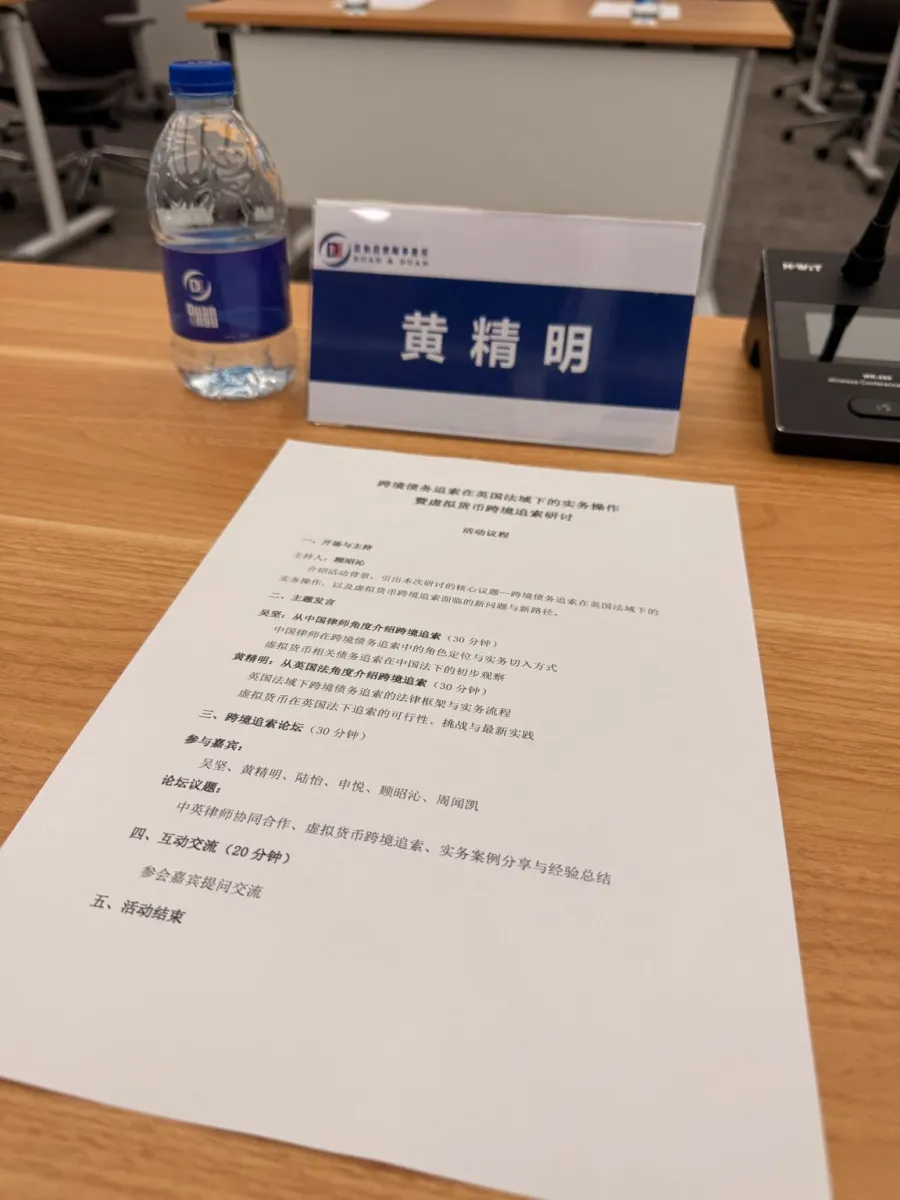
The room was full, and the questions ran well past the scheduled finish.
Frequently asked questions
Can a Chinese court judgment be enforced in England?
Yes. There is no treaty between the UK and the People's Republic of China for the reciprocal enforcement of judgments, but a final PRC judgment for a fixed sum of money can be enforced in England at common law. The creditor brings a fresh claim in the English court treating the judgment as a debt, usually followed by an application for summary judgment.
What conditions must a PRC judgment meet to be enforced at common law?
The judgment must be final and conclusive in the court that gave it, it must be for a fixed or ascertainable sum of money, and the Chinese court must have had jurisdiction over the debtor in the eyes of English law: for example because the debtor was present or resident in China when the proceedings began, took part in them, or had agreed to the Chinese court's jurisdiction. The debtor can resist enforcement only on narrow grounds such as fraud, breach of natural justice or English public policy.
Does it matter that the debtor left China before the Chinese proceedings started?
Not necessarily. In Li v Yuan [2026] EWHC 242 (Comm) the debtors said they had moved to Cyprus before the Nanjing proceedings began. The English court examined the border entries in their passports and other evidence, found they were still resident in Nanjing when the claims were issued, and held that residence was enough to give the Chinese courts jurisdiction. The judgments, worth about £28.4 million, were enforced.
Is PRC 'double interest' for late payment enforceable in England?
It can be. In Hangzhou Jiudang Asset Management v Kei [2022] EWHC 3265 (Comm) the Commercial Court held that the additional interest imposed under Article 253 of the PRC Civil Procedure Law on a debtor who pays late pursues a legitimate aim and is not an unenforceable penalty contrary to English public policy.
Can a Chinese creditor freeze a debtor's assets in England before enforcement?
Yes, where the evidence justifies it. The English court can grant a worldwide or domestic freezing injunction in support of a claim on a foreign judgment; the creditors in Hangzhou Jiudang obtained one before their summary judgment application was heard.